Kitesurfing Equipment: The Complete Gear List (and What It Costs)
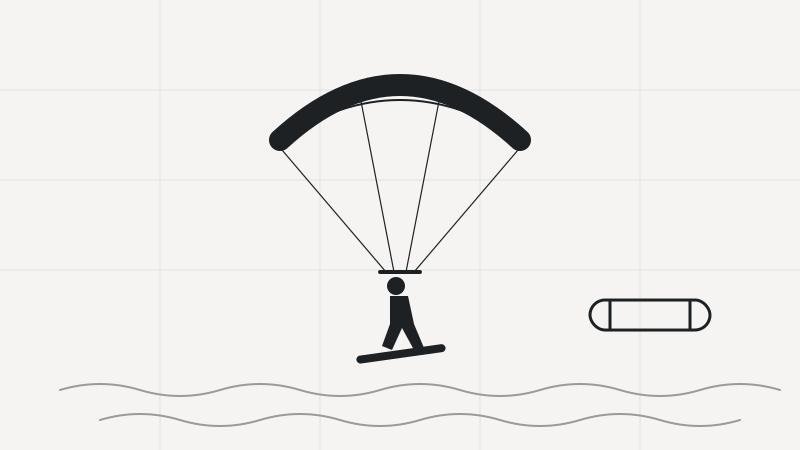
Kitesurfing equipment can look complicated: dozens of brands, several kite styles, sizes from 5 to 17 square meters and boards for every discipline. In reality a complete setup has only a handful of parts, and once you understand what each one does, choosing gear gets much easier. This guide walks through every piece of kitesurfing equipment, how to size it, what it costs and how to avoid paying full price.
The core kitesurfing equipment list
- Kite: the engine. Usually an inflatable kite between 7 and 14 square meters.
- Control bar and lines: how you steer, power up and depower the kite, and where the safety release lives.
- Board: a twin-tip for most riders, a surfboard for waves or a hydrofoil for light wind.
- Harness: connects you to the bar so your body, not your arms, takes the pull.
- Wetsuit: sized to the water temperature where you ride.
- Safety gear: helmet, impact vest and a line knife.
- Pump and leash: to inflate the kite and keep it attached to you.
Kiteboarding equipment and kitesurfing equipment are the same thing. The two names for the sport are used interchangeably, as we explain in our beginner’s guide to kite surfing.
Kites
Inflatable vs foil kites
Almost all kitesurfing kites are leading edge inflatable (LEI) kites. Inflatable tubes give the kite its shape and let it float and relaunch from the water. Foil kites have no tubes and fill with air through vents. They're light and efficient, which makes them popular for light wind, hydrofoiling and snowkiting, but they're harder to relaunch from the water and not recommended for beginners.
Kite styles
- Freeride / all-round: stable, easy to relaunch, with a wide wind range. The best first kite for almost everyone.
- Freestyle: a direct feel and strong pop for unhooked tricks. Less forgiving.
- Big air: built for height and hang time. Lots of power and lift.
- Wave: drifts well and turns quickly so you can ride a surfboard in waves.
- Light wind: larger kites designed to fly in 8 to 12 knots, often paired with a foil.
What size kite do you need?
A widely used rule of thumb is:
Kite size (m²) ≈ your weight (kg) ÷ wind speed (knots) × 2.2
For a 75 kg rider in 18 knots, that's 75 ÷ 18 × 2.2 ≈ 9 m². Treat it as a starting point. Board size, skill level and how gusty the wind is all shift the answer. Most riders end up with a two-kite quiver, for example a 9 m and a 12 m for an average-weight adult, which covers the majority of rideable days.
Control bar and lines
The bar is your steering wheel, throttle and emergency brake in one. Modern bars use four or five lines, typically 20 to 24 meters long, and include a depower strap to adjust the kite's power and a quick-release that flags the kite out when you pull it.
Most brands design their bars to work best with their own kites, so when you buy used gear, a matching kite and bar from the same brand is the simplest option. Check line wear, the release mechanism and the center line for fraying before you buy.
Boards
Twin-tip
A twin-tip is symmetrical, so you can ride in either direction without turning the board around. It's what nearly every kitesurfer learns on and what most people ride most of the time. Sizes usually range from about 130 to 145 cm long. Heavier riders and light-wind days call for bigger boards, while lighter riders and strong wind call for smaller ones.
Surfboard (directional)
Directional boards are for riding waves and carving. They're ridden with or without foot straps and need a different technique for turning, so most riders add one after they're confident on a twin-tip.
Hydrofoil
A foilboard has a mast and wings under the board that lift it above the water. Foiling opens up very light wind days and smooth, quiet riding, but it's a separate skill to learn, and foil gear is among the most expensive kitesurfing equipment.
Harness
- Waist harness: sits around your lower back. More freedom of movement, preferred by most riders. Hard-shell waist harnesses spread the load especially well.
- Seat harness: includes leg straps and sits lower, so it can't ride up. Often more comfortable for beginners and riders with lower back issues.
Fit matters more than brand. A harness that rides up into your ribs will ruin a session, so try before you buy if you can.
Wetsuit
Choose thickness by water temperature, not air temperature:
- Above about 24°C (75°F): board shorts, a rash vest or a shorty.
- About 18 to 24°C (64 to 75°F): a 3/2 mm full suit.
- About 14 to 18°C (57 to 64°F): a 4/3 mm full suit.
- Below about 14°C (57°F): a 5/4 mm suit with boots, gloves and a hood.
Safety gear
- Helmet: essential while learning and for anyone riding near other people or hard obstacles.
- Impact vest: protects your ribs and adds some buoyancy. It's not a life jacket.
- Line knife: most harnesses have a pocket for one. It lets you cut yourself free if lines tangle around you.
How much does kitesurfing equipment cost?
Rough new prices for current-season gear:
- Kite: $1,000 to $2,200
- Bar and lines: $400 to $800
- Twin-tip board: $400 to $1,000
- Surfboard: $700 to $1,300
- Hydrofoil set: $1,000 to $2,500 or more
- Harness: $150 to $500
- Wetsuit: $150 to $600
- Helmet and impact vest: $150 to $400 together
- Pump: $50 to $100
A complete new beginner setup with one kite, bar, twin-tip and harness comes to roughly $2,000 to $4,000.
How to save money on kitesurfing gear
Buy last season’s models
Kite brands release new models every year, and the changes between years are often small. When the new range arrives, shops discount the previous season's stock heavily. Discounts of 30 to 50 percent are common, and older models can go even lower. For most riders, a one or two-year-old kite performs almost identically to the newest version. Our deals page tracks the biggest current discounts on kites, boards, bars, wetsuits, harnesses and foils.
Buy used, carefully
Used gear can be great value. Before buying, check:
- The canopy for repairs, tears and porosity (it should feel crisp, not soft).
- The bladders by inflating the kite and leaving it for an hour to make sure it holds air.
- The leading edge and struts for patches and seam damage.
- The bar and lines for wear, knots and a working quick release.
- The board for delamination, cracks and worn fins or straps.
Buy a package
Many shops offer kite, bar and board packages at a lower price than buying each piece separately. Package deals on previous-season gear are often the cheapest way to get a complete, matched setup.
Beginner kitesurfing equipment checklist
- One freeride kite in your most-used size, plus a second size when budget allows.
- A matching bar from the same brand as your kite.
- A forgiving twin-tip in the right size for your weight.
- A harness that fits well (waist or seat).
- A wetsuit for your local water temperature.
- A helmet and an impact vest.
- A pump and a kite leash.
Haven't taken lessons yet? Start there before buying anything. Our kiteboarding lessons guide explains what to expect.